In recent years, AI chatbots have become commonplace in businesses. They answer employees’ questions, assist customers, and streamline simple, repetitive tasks.
But a new generation of tools is emerging: intelligent agents. More powerful and autonomous, they represent a significant evolution in artificial intelligence. Understanding the difference between these two approaches is essential for keeping pace with changing trends and better anticipating the future.
What is an intelligent agent?
An intelligent agent, orAI- d agent, is an autonomous software program capable of perceiving its environment, reasoning to analyze the situation, and selecting an action. It is an operational entity capable of interacting with business software, orchestrating workflows, and achieving a specific objective.
Unlike a chatbot, an intelligent agent is not just a conversational tool. It is designed to perform tasks, orchestrate processes, and make decisions within a defined scope.
As a result, the intelligent agent is capable of:
- Perceive: It gathers information, data, and contextual details about its surroundings.
- Reasoning: He analyzes the situation and chooses the most appropriate course of action.
- Take action: He performs specific tasks in various systems.
- Learning: It improves through experience and feedback, enabling it to solve increasingly complex problems.
A concrete example of an intelligent agent in action: An AI agent for technical support can: identify a reported issue, automatically trigger the resolution process, update the IT tool, and notify the user when the task is complete. Whereas a chatbot is limited to dialogue, an intelligent agent acts as an autonomous entity capable of directly transforming business workflows!
However, its autonomy remains limited: it operates according to set objectives and still requires oversight and control mechanisms to ensure reliability and safety.
The Role of Generative AI in the Operation of Autonomous Agents
The development ofgenerative AI has revolutionized the capabilities of chatbots.Advanced language models(LLMs) have enabled autonomous chatbots to reach a new level. These systems are now capable of understanding and generatingnatural language (NLP) with unprecedented fluency and accuracy.
- In-depth understanding of user intent: Thanks to generative AI, the agent can interpret requests phrased in natural language, even if they are complex or ambiguous.
- Enhanced reasoning ability: The agent can use logical processes to break down a complex task into simpler subtasks.
- Action orchestration: It no longer simply generates a response; it can initiate specific actions to achieve a goal, such as sending an email, updating a database, or creating a ticket.
By leveraging generative AI, intelligent agents are becoming true all-around assistants, capable of performing tasks that go beyond simple conversational exchanges to deliver a richer and more effective customer or user experience.
Smart Agents vs. AI Chatbots: Understanding the Differences
What is an AI chatbot?
An AI chatbot is a conversational interface that uses artificial intelligence to interact with users in natural language. It can understand a request, provide a relevant response, and sometimes draw on knowledge bases or internal systems to personalize its responses.
A concrete example of an AI chatbot in action: an AI chatbot designed for internal support can help an employee reset their password, explain the process for requesting time off, or direct an employee to the appropriate HR or IT resource.
An AI chatbot is therefore a tool designed for interaction, ideal for simple, routine interactions. Its purpose is to make information more accessible, automate responses to frequently asked questions, and save teams time.
But unlike an AI agent, its role is limited to dialogue and assistance, with no real autonomy in carrying out complex processes.
The smart assistant: a standalone system designed to boost productivity
An intelligent assistant, on the other hand, is an autonomous software entity capable of reasoning, taking action, and collaborating with other systems to achieve a goal. While a chatbot is a conversational tool, an agent is an operational entity that can:
- Make decisions independently.
- Integrate with other systems (APIs, business tools, databases) for comprehensive orchestration.
- Manage complex tasks such as cross-departmental coordination or workflow management.
| AI Chatbot (Conversational) | AI Agent (autonomous) | |
| Main objective | Engage in conversation, answer questions | Achieve a goal, carry out a mission |
| Battery life | Depends on the rules or prompts | Makes decisions and acts independently based on objectives |
| Environment | Limited to the chat interface | Connected to multiple systems (APIs, business tools, data) |
| Complexity of tasks | Basic (FAQ, information search) | Complex (orchestration, multi-system coordination) |
| Development | Manually enhanced (addition of rules/data) | Learns and adapts over time |
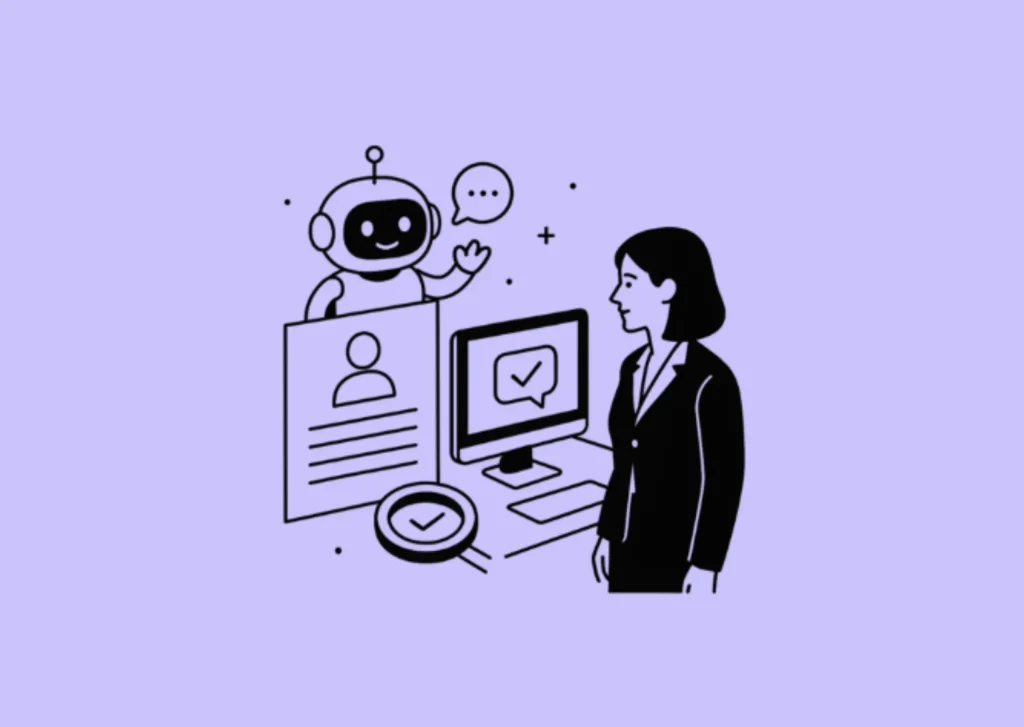
Chatbots and intelligent agents: complementary uses
It would be tempting to view chatbots and AI agents as two successive generations. In reality, their roles are different and often complementary. The intelligent agent expands the range of possibilities, covering a broader spectrum of needs that go beyond simple dialogue.
- AI chatbots: ideal for simple, frequent, and low-risk interactions (FAQs, administrative requests, internal support). They provide a fast and accessible first line of response.
- AI agents: suited for more complex and cross-functional tasks (process orchestration, coordination between systems, limited decision-making).
Within an organization, the two can coexist harmoniously:
- An AI chatbot greets visitors, filters inquiries, and answers common questions,
- An intelligent agent takes over when an action needs to be triggered or a business workflow needs to be orchestrated.
Rather than replacing chatbots, agent-based AI expands the range of possibilities and addresses a broader spectrum of needs.
An AI chatbot is a conversational tool designed for interaction.
An AI agent, on the other hand, is an autonomous software entity capable of reasoning, acting, and collaborating with other systems to achieve a goal.
These two approaches reflect two different levels of maturity in the evolution of artificial intelligence.
- AI chatbots are the present—widely used and always helpful.
- The intelligent agent represents a new, more ambitious phase that shapes the future of AI automation.
In short: rather than pitting them against each other, we need to understand how they can coexist and complement each other in the digital transformation of businesses.
How to Create Intelligent Agents for Your Business?
The steps involved in implementing an intelligent agent
The creation of anintelligent agent in an enterprise environment is a structured process, the success of which depends on a rigorous methodological approach.
- Define the objective: It is essential to identify a specific problem to be solved. This could involve automating recurring tasks, improving ticket management, or optimizing customer relations.
- Collecting data: The agent needs information to carry out their tasks. This may come from databases, enterprise systems (CRM, ERP), or communication tools.
- Implement the design and configuration: this involves defining the agent’s architecture, its rules, and its interactions with the company’s intelligent systems.
- Proceed to the testing and iteration phase: the agent must be tested under real-world conditions and adjusted based on feedback. Updates are released frequently to improve its effectiveness.
Use cases for automating specific tasks
Here are the main complex tasks that self-employed can can automate in each department:
- HR: Manage the onboarding of new employees, answer questions about internal policies, and automate requests for time off or training.
- IT: Monitor systems to prevent outages, manage technical incidents, and automate password resets and software updates.
- GRU & Customer Service: They sort requests, route tickets to the appropriate teams, and coordinate information across different systems to improve the customer experience.
Thanks to this automation, human agents can focus on strategic tasks, while intelligent agents handle day-to-day operations.
Ready to explore the Wikit Semantics platform?
Explore the platform's features and discover the potential of AI for your organization!
